A Premium Aluminum Entry Door does more than mark a building’s entrance. It must welcome visitors, resist weather, and operate smoothly through years of daily use. The best models pair carefully finished aluminum frames with insulated glass, secure hardware, and dependable weather seals. Yet a polished showroom sample cannot reveal everything. Installation quality and site conditions matter just as much.
Building-science expert Dr. Joseph Lstiburek offers a useful principle, paraphrased here: “A door performs only as well as its frame, seals, and installation.” That perspective helps explain why comparing manufacturers requires more than checking finishes or catalog dimensions. Buyers should examine thermal performance, water management, hardware options, customization, warranty terms, and the company’s record of supporting projects after delivery. Details count. A narrow gasket, poorly aligned threshold, or exposed coastal location can change how a door performs.
This guide introduces leading Premium Aluminum Entry Door manufacturers worldwide and the qualities that distinguish their offerings. It considers design range, engineering, production expertise, and practical suitability for different buildings. No single manufacturer is right for every project. Some claims also deserve a closer look; product descriptions do not always show how a door will perform in a real opening. Comparing specifications with project needs—and confirming details directly with manufacturers—offers a more reliable starting point.
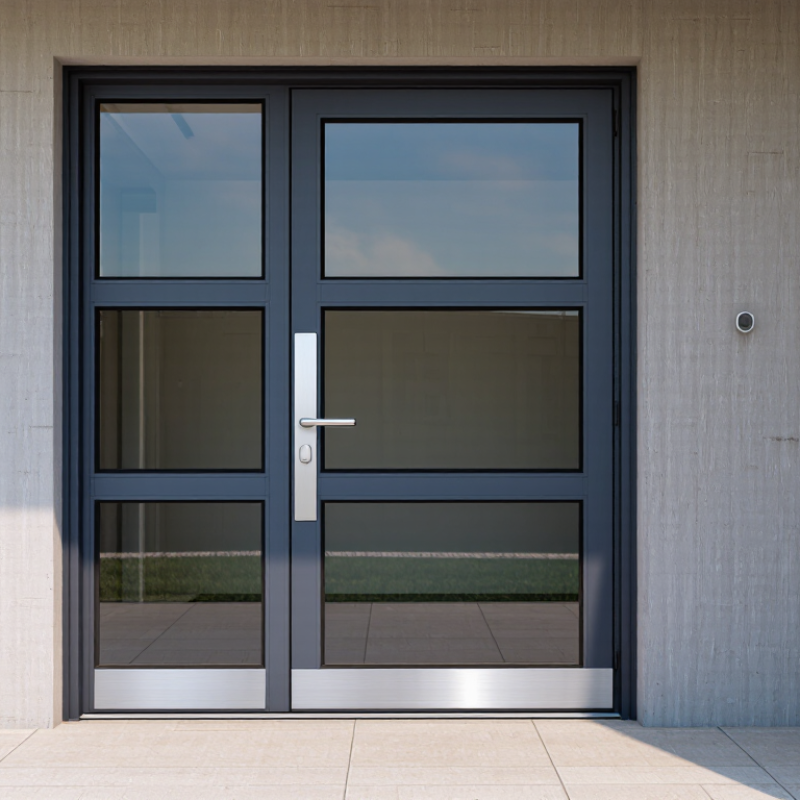
A premium aluminum entry door is more than a heavy frame and a clean finish. EN 14351-1 provides a product-standard framework for assessing windows and external pedestrian doorsets. It helps buyers compare declared performance, rather than relying on appearance or broad marketing claims.
Look for documented results relevant to the intended opening. Air permeability, watertightness, resistance to wind load, and thermal transmittance can affect comfort and durability. Acoustic performance may also matter near a busy street. Check that the evidence matches the door’s actual configuration, including its size, glazing, seals, and hardware. Small changes can affect performance.
Details matter. A beautiful threshold can still leak in driving rain. A test report is useful, but it does not guarantee the same result after poor installation or years of wear. Ask how the door was assessed, which characteristics are declared, and whether the tested assembly resembles the one being offered. EN 14351-1 does not rank doors as “premium”; careful comparison of verified values, construction details, and installation guidance gives that term practical meaning.
Water-tightness is one of the performance characteristics associated with external doorsets under EN 14351-1. The chart shows the pressure levels associated with classes 1A–9A in EN 12208. These are standard classification thresholds, not ratings for any particular manufacturer or a universal definition of “premium.”
Higher classes correspond to higher test pressures in this classification. Actual door performance depends on the tested product configuration and declared results.
For premium aluminum entry doors, thermal performance is best compared through the NFRC 100 U-factor, not frame material alone.
NFRC 100 specifies a standardized method for evaluating heat transfer across the complete fenestration product. A lower U-factor means less heat passes through the door. Check that each rating covers a comparable size, glazing package, and configuration; sidelights can change the result.
Small details matter. A thermal break separates interior and exterior aluminum, while insulated glass and well-sealed edges help limit heat flow. The U.S. Department of Energy’s Energy Saver guidance estimates that windows account for about 25–30% of residential heating and cooling energy use. That figure concerns windows broadly, not entry doors specifically, but it shows why the glazed area deserves attention.
Compare certified NFRC ratings, then inspect installation details, including the threshold and perimeter seals. Numbers are useful. Context matters. A lab-rated door may perform differently if installation leaves a draft at the sill, and comparing unlike configurations can make a ranking misleading. NFRC 100 and the Department of Energy’s Energy Saver guidance provide useful reference points, but neither replaces checking the exact product configuration and local project conditions.
Premium aluminum entry doors combine a slim appearance with the strength needed for frequent daily use. Established manufacturers worldwide typically offer systems with thermal breaks, multi-point locks, and finishes designed to resist fading. Details matter. Ask how the complete door assembly performs, not just the aluminum frame. Glass, seals, threshold, and installation can all affect comfort and weather resistance.
A useful comparison starts with measurable evidence. Request air-leakage, water-resistance, and structural test results for a configuration close to your planned door. Check the corners. Look for consistent joints, smooth hardware movement, and drainage paths that do not trap water. In coastal areas, confirm that the coating and fasteners suit salt exposure. A polished brochure is not proof. Warranty terms, replacement-part access, and local installer training also deserve attention. Some specifications may look impressive but apply only to a different size or glazing option. That distinction matters. Even a premium system can disappoint if the opening is poorly measured or the threshold is unsuitable. Ask for written, project-specific details before choosing.
Technical comparison guide: performance depends on the complete door assembly, its dimensions, glazing, hardware, test method, and installation. The benchmarks below describe recognized standards and evaluation criteria, not ratings for any specific manufacturer.
| Evaluation dimension | Recognized metric or reference | How to interpret it | What to request |
|---|---|---|---|
| Product performance declaration | EN 14351-1 | European product standard covering performance characteristics for external pedestrian doorsets and windows. | The performance declaration and documentation for the exact door configuration and intended market. |
| Air permeability | EN 12207; ASTM E283 test method | EN 12207 uses Classes 1–4, with Class 4 the highest classification. ASTM E283 reports air leakage under specified test conditions; acceptance limits depend on the project requirements. | The test report, tested size, pressure conditions, and leakage result or classification. |
| Watertightness | EN 12208; ASTM E331 test method | EN 12208 includes Classes 1A–9A; Class 9A corresponds to a test pressure of 600 Pa. ASTM E331 evaluates water penetration under specified conditions. | The tested water pressure, exposure duration, specimen details, and any reported leakage. |
| Wind resistance and deflection | EN 12210; ASTM E330 test method | EN 12210 pressure Classes 1–5 correspond to 400–2,000 Pa. Its deflection classes A, B, and C specify limits of 1/150, 1/200, and 1/300 of the relevant frontal length, respectively. | The pressure and deflection classification, tested configuration, and project design wind load. |
| Thermal performance | U-factor / thermal transmittance, typically reported in W/m²·K or Btu/h·ft²·°F | A lower U-factor indicates lower heat transfer. Results vary with door size, frame, panel, glazing, and calculation or test method. | A whole-door value for the specified configuration, with the calculation or test basis clearly identified. |
| Glazing solar performance | Solar heat gain coefficient (SHGC) and visible transmittance (VT) | SHGC indicates the fraction of solar heat admitted through glazing; VT indicates the fraction of visible light transmitted. These values apply to the glazing, not automatically to the complete door. | Glazing-specific values and the exact glass build-up for doors with vision panels or sidelights. |
| Acoustic insulation | Rw or STC, as applicable to the test and market | Higher ratings generally indicate better sound reduction in the applicable rating system. Results depend on the complete doorset, seals, and installation. | A laboratory report for the complete assembly, including the tested size and glazing or panel specification. |
| Finish durability | AAMA 2604 / AAMA 2605 for organic coatings; AAMA 611 for anodized architectural aluminum | These specifications define performance requirements for coating or anodized finishes. AAMA 2605 has more stringent requirements than AAMA 2604. | The finish specification, color, exposure conditions, and applicable warranty terms. |
| Hardware and security | Locking, cylinder, hinge, and applicable local security requirements | Security depends on the complete system, including the frame, door leaf, locks, hinges, glazing, and installation; there is no single universal rating for all markets. | Hardware schedule, security certification where required, and confirmation that components are compatible with the selected door. |
| Installation and project suitability | Project-specific structural, weather, thermal, accessibility, and code requirements | Laboratory results apply to tested specimens. Site performance also depends on opening preparation, anchorage, perimeter sealing, drainage, and workmanship. | Installation details, approved opening dimensions, maintenance guidance, and written confirmation of code compliance. |
Note: Compare like-for-like test evidence. Performance ratings should be checked against the same door size, opening direction, panel or glazing build-up, hardware, and applicable standard.
For premium aluminum entry doors, coating performance is more than a color choice. South Florida’s intense sun, humidity, and salt-laden air can expose weak points at corners and hardware cutouts. The FGIA AAMA 2605 specification sets a demanding benchmark: ten years of outdoor exposure in South Florida, with color change limited to ΔE 5 and chalking rated at least 8 under the specified evaluation methods. These are measured outcomes, not a promise that every doorway will age identically.
The exposure test uses a south-facing panel mounted at a prescribed angle, so sunlight strikes the finish for years. That matters. A dark door on a shaded porch faces a different real-world load than a sunlit coastal entrance. The standard also includes laboratory checks, such as thousands of hours of humidity and salt-spray exposure; those results help compare coating systems, but they cannot reproduce every installation detail.
Ask for the test report, not just a “2605 compliant” claim. Check the tested color, pretreatment, film thickness, and substrate against the door being specified. Small differences count. A cut edge can become a weak spot if fabrication or sealing is poor. Even a strong coating needs careful installation and occasional cleaning. I’d also want to know how the finish looks after several years in the actual climate; standards are useful, but they do not remove every uncertainty.
Premium aluminum entry doors should be compared by tested performance, not appearance alone. The FBI’s 2023 Crime in the United States report recorded 847,522 burglary offenses nationwide. That figure does not identify door failures, but it makes security hardware worth close review. Ask whether the complete door assembly has been tested, and check lock reinforcement, hinge protection, and glass placement. Details matter.
For performance, look for documentation against NAFS, the North American Fenestration Standard, which evaluates air leakage, water penetration, and structural performance. It does not certify a door against forced entry. ASTM F476 provides a separate test method for swinging door assemblies. NFRC labels can help compare a door’s U-factor and solar heat gain coefficient, especially when insulated glazing is specified. Not interchangeable. Custom options also deserve scrutiny: thermal breaks, threshold height, glazing, and finish choices can affect comfort, accessibility, and upkeep.
Warranty language can be less clear than a product sheet. Compare coverage for the aluminum finish, glass, hardware, labor, and installation, then check exclusions for coastal exposure or maintenance. One gap deserves reflection: a long coverage period may offer little value if labor is excluded. Ask whether the warranty transfers to a future owner, and request the terms in writing before ordering.
It provides a framework for declaring door performance. It does not rank doors as premium. Compare documented results for the exact configuration.
Review air permeability, water resistance, wind-load resistance, and thermal transmittance. Acoustic performance may matter beside a busy street.
Size, glazing, seals, and hardware can change performance. A report for another configuration may not reflect your doorway.
Check neat frame joints, moving hardware, and clear drainage paths. Details matter. A fine-looking threshold can still let in driving rain.
No. Poor measuring, fitting, or later wear can affect results. I would want clear installation guidance, though reports cannot predict every problem.
Ask for documented exposure-test results and check whether the tested color, pretreatment, film thickness, and substrate match your door. Salt and strong sun are demanding.
Under specified methods, it limits color change to ΔE 5 and requires a chalking rating of at least 8. Real doorways may age differently.
Request project-specific details, warranty terms, replacement-part access, and installer training. A brochure alone is not enough. Check the threshold carefully.
A Premium Aluminum Entry Door should be assessed not only by its appearance, but also by its documented performance. EN 14351-1 provides a framework for evaluating key product characteristics, while NFRC 100 U-factor ratings help compare how effectively different doors limit heat transfer. These measures can support more informed choices, though actual performance depends on the complete door system, installation, and project conditions.
When comparing manufacturers and products, consider thermal efficiency alongside security features, customization options, relevant certifications, and warranty coverage. Coating durability is another important factor: AAMA 2605 includes a demanding 10-year South Florida exposure test that can help indicate resistance to weathering and color change. Reviewing these criteria together makes it easier to identify an entry door suited to a building’s design, climate, and long-term maintenance expectations.

Shieldoors