Choosing an Aluminium Entry Door is more than selecting a stylish frame. It affects security, comfort, maintenance, and energy performance.
The International Energy Agency’s Buildings 2024 report states that buildings consume about 30% of global final energy. It also attributes around 26% of energy-related emissions to the building sector. These figures make door performance worth closer attention. A beautiful entrance can still leak heat around its threshold. It may also admit rain through poorly sealed joints.
This guide presents seven practical tips for making a more informed choice. Look for a thermally broken frame, tested air-tightness, secure multi-point hardware, and a low U-value. Check the threshold height and drainage channels, especially where heavy rain is common. Coastal homes need suitable powder coatings and corrosion-resistant fittings. Small details matter. A weak cylinder can undermine a strong door leaf.
The International Aluminium Institute reports that roughly 75% of all aluminium ever produced remains in productive use. That supports aluminium’s long-term material value, but it does not excuse careless purchasing. Manufacturing quality, recycled content, finish durability, and installation standards still vary between suppliers. Some product brochures sound impressive. They may not show independent test results.
Real performance depends on the whole entrance assembly, not the frame alone. Ask for documented thermal, security, water, and air-infiltration testing. Compare those results with your climate and building requirements. The cheapest quotation may become expensive after adjustment, repainting, or replacement. A careful decision now can prevent a cold hallway, rattling hinges, and avoidable repair costs later.
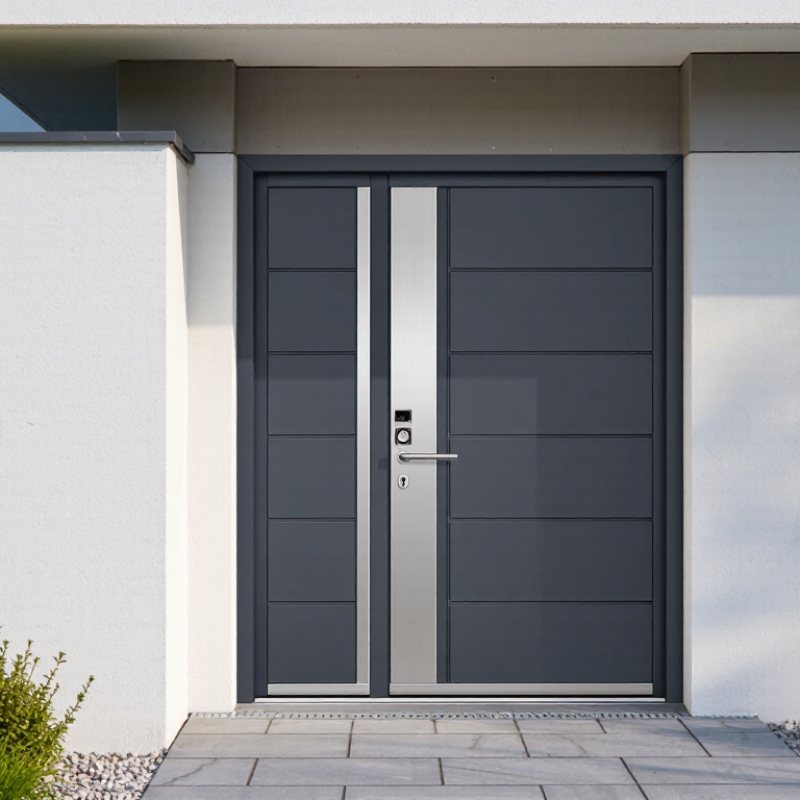
7 Tips for Choosing the Best Aluminium Entry Door
Set a thermal target before comparing styles. Choose an NFRC-rated door with a U-factor of 0.30 or lower. Lower U-factor means less heat passes through the assembly. Aim for an SHGC of 0.23 or lower in hot, sunny climates. The U.S. Department of Energy identifies windows and doors as important contributors to residential heat gain and loss. NFRC certification provides tested performance data, not sales language. Check the complete product label.
Look for insulated aluminium frames with continuous thermal breaks. Select low-emissivity glazing, warm-edge spacers, and a tightly sealed insulated core. Ask whether the rating covers the entire door system, including the frame and glass. Inspect weatherstripping around all four edges. A small daylight gap can become a large comfort problem. Choose a multi-point lock for steadier compression. Confirm the sill drains water away from the threshold.
Installation deserves equal attention. The 2021 International Energy Conservation Code emphasizes controlled air leakage and climate-specific performance. A high-rated door may underperform if the opening is warped or poorly flashed. Ask for measured air-leakage results, installation tolerances, and warranty terms. I have seen attractive doors fail at the threshold because the floor was uneven. That is an easy detail to miss. Recheck the numbers, especially when a supplier offers only center-of-glass values instead of whole-door performance.
| Selection Area | Recommended Specification | Thermal or Performance Target | Why It Matters | What to Verify |
|---|---|---|---|---|
| 1. Define the whole-door thermal target | Specify a complete, tested door assembly rather than relying only on the frame or glass rating. | NFRC U-Factor ≤ 0.30 Btu/h·ft²·°F SHGC ≤ 0.23 |
A lower U-Factor reduces conductive heat transfer. A lower SHGC limits solar heat gain through glazed areas. | Request the NFRC-certified whole-product values for the exact size, configuration, glazing, sidelites, and transom. |
| 2. Choose a thermally broken aluminium frame | Use a continuous polyamide or equivalent thermal barrier between the interior and exterior aluminium sections. | Thermal-break width and location should be optimized by thermal simulation; avoid direct metal paths through the frame. | Aluminium conducts heat efficiently. A continuous thermal barrier lowers frame heat flow and helps reduce interior condensation risk. | Check section drawings for a continuous barrier at the jambs, head, sill, and threshold, not only at isolated frame locations. |
| 3. Select low-solar-gain insulating glass | Use double or triple insulating glass with a low-emissivity coating, argon fill, and sealed insulating-glass construction. | For a double-glazed unit, a center-of-glass U-Factor around 0.24–0.30 Btu/h·ft²·°F is a practical design reference; the complete door must still meet the whole-product target. | Glazing often occupies the largest area of a glazed entry door and strongly affects both U-Factor and SHGC. | Confirm glass make-up, coating surface, gas fill, cavity thickness, and the certified whole-door result—not just center-of-glass data. |
| 4. Control solar heat gain | Use a solar-control low-E coating selected for the building orientation and local climate. | SHGC ≤ 0.23 for the specified assembly; visible transmittance should be selected according to daylight needs. | Low SHGC helps reduce unwanted summer heat gain, especially on south-, west-, and southwest-facing openings in cooling climates. | Check whether the stated SHGC applies to the complete door system and whether shading, orientation, and local energy-code requirements are considered. |
| 5. Improve the edge and spacer system | Specify a warm-edge spacer and a properly sealed insulating-glass perimeter. | Use a low-conductivity spacer system compatible with the selected glass and sealants; avoid unverified claims based only on spacer material. | The glass edge is a common thermal bridge. A better spacer can improve edge temperatures and reduce condensation potential. | Review spacer type, primary and secondary seals, compatibility with the frame, and condensation-resistance data where available. |
| 6. Seal the opening against air leakage | Use continuous compression weatherstripping, a sealed sill, adjustable hinges, and accurately aligned door hardware. | Target low air leakage and verify the rating using the applicable fenestration test method; installation quality must match the product design. | Air leakage can cause drafts, energy loss, moisture movement, and comfort complaints even when the frame and glass have good laboratory ratings. | Check corner seals, meeting-stile seals, threshold adjustment, gasket compression, and the tested air-leakage result for the complete unit. |
| 7. Verify installation and field conditions | Use a plumb, level, square, insulated, and continuously sealed rough opening with drainage and flashing appropriate to the wall system. | Maintain a continuous air, water, and thermal-control layer around the perimeter; do not block designed drainage paths. | Even a high-performing door can underperform if the rough opening, threshold, perimeter seal, or flashing is incorrectly installed. | Confirm approved installation details, sill pan or equivalent water management, perimeter insulation, sealant compatibility, and final adjustment. |
| Recommended documentation package | Collect the product data sheet, NFRC values, shop drawings, glass specification, installation instructions, and test reports. | Values must correspond to the exact door size, frame, glazing, sidelites, transom, hardware, and threshold configuration. | Thermal performance is configuration-specific. Substituting glass or changing dimensions can alter the certified result. | Treat calculated or component-only values as design guidance until the complete assembly is independently tested or certified. |
Look for a whole-door U-factor of 0.30 or lower. A lower value means less heat passes through the assembly. In hot, sunny climates, target an SHGC of 0.23 or lower. Check the complete rating label.
Choose an insulated aluminium frame with a continuous thermal break. Low-emissivity glass, warm-edge spacers, and an insulated core also help. Ask whether the rating includes the frame and glazing. Centre-glass figures can mislead.
Inspect weatherstripping along all four edges. Even a narrow daylight gap can create noticeable discomfort. A multi-point lock can provide steadier compression. Confirm that the sill drains water away from the threshold.
A strong door can perform poorly in a warped opening. Poor flashing may allow water behind the frame. Ask for installation tolerances and measured air-leakage results. The floor must be level.
Request documented coating performance, including weathering, adhesion, gloss, and colour stability. Inspect samples in direct daylight. Look for pinholes, uneven gloss, sharp edges, and damage near hinges. Colour alone proves little.
No. Salt spray is a controlled test, not a complete coastal forecast. Review exposure hours, corrosion ratings, blistering, and scribe details. Confirm the tested alloy, pretreatment, coating thickness, and hardware match the proposed door. Coastal doors still need fresh-water washing.
Measure width, height, depth, and squareness at several points. Record the finished opening, not only the old door size. Check threshold height, swing direction, floor clearance, and drainage space. A few millimetres matter.
Read coverage for coating, hardware, seals, glass, installation, and coastal corrosion. A long frame warranty may exclude labour or moving parts. Compare delivery, fitting, maintenance, energy loss, and future glass replacement. Cheap is not always economical. I still underestimate small hardware costs sometimes.
Choosing the best Aluminium Entry Door requires more than comparing appearance and price. Start by defining your thermal performance goals, such as an NFRC U-Factor of 0.30 or lower and an SHGC of 0.23 or lower, to support indoor comfort and energy efficiency. Next, check that the door has reliable airtightness, water management, and drainage performance verified against AAMA/WDMA/CSA 101/I.S.2/A440 requirements. Security should match your property’s risk level, with EN 1627 RC2 or RC3 certification providing a clear benchmark for resistance.
Also evaluate the finish carefully. AAMA 2605 compliance and documented salt-spray testing can indicate stronger durability in demanding environments. Before ordering, confirm the exact dimensions, glazing specifications, installation details, warranty coverage, and expected maintenance needs. Finally, compare whole-life cost rather than focusing only on the initial purchase price, so the door delivers lasting value, protection, and performance.

 Shieldoors