2026 Best Modern Aluminum Entry Door for Global Buyers?

Time:2026-10-24 Author:Amelia
0%

Choosing the right Modern Aluminum Entry Door in 2026 requires more than comparing attractive showroom images. Global buyers must consider climate, security expectations, installation methods, and local building requirements. A door that performs well in a mild coastal city may struggle in a freezing inland region. Material selection matters.

This guide examines aluminum grades, thermal-break systems, weather seals, glass options, hinges, locks, finishes, and threshold design. It also considers measurable details, such as frame depth, U-value, air leakage, water resistance, and wind-load performance. Reliable manufacturers should provide technical drawings, test reports, warranty terms, and clear maintenance instructions. Certifications deserve verification, not blind trust.

Small details affect daily use. A poorly aligned threshold can collect rainwater. Dark powder coating may become noticeably hotter under direct summer sunlight. Oversized glass can improve daylight but increase weight and hardware demands. These are practical concerns often missed in polished product descriptions.

There is no universal best door.

Supplier experience matters, but it is not enough. Buyers should request installation references, sample finishes, packaging photographs, and replacement-part policies. Lead times may change because of glass production, customs procedures, or project-specific dimensions. Those risks require honest planning.

This introduction offers a balanced framework for evaluating modern aluminum entrance systems across different markets. It favors documented performance over impressive wording. Some recommendations may need adjustment after a site inspection. That is a limitation worth admitting. A durable purchase depends on verified specifications, competent installation, and realistic expectations.
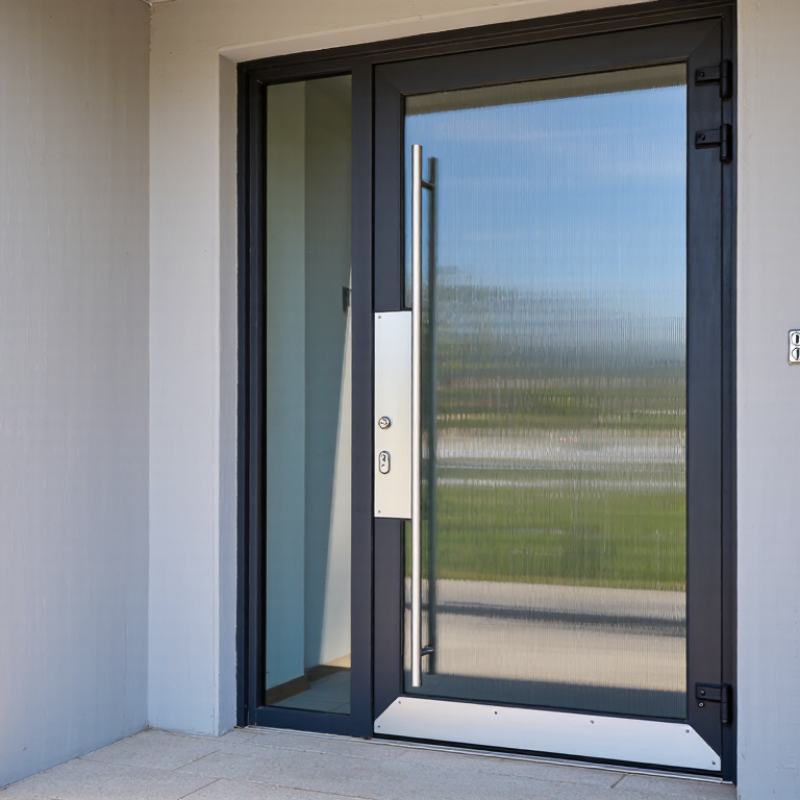
2026 Best Modern Aluminum Entry Door for Global Buyers?

What Defines a Modern Aluminum Entry Door in 2026

In 2026, a modern aluminum entry door means more than a slim frame and dark finish. It combines thermal performance, security, durability, and verified environmental information. The International Energy Agency’s 2023 Global Status Report states that buildings use about 30% of global final energy. A well-designed entrance can reduce drafts and limit unwanted heat transfer.

The key detail is the thermal break.

It separates interior and exterior aluminum with an insulating material. Add insulated glazing, compression seals, and a thermally improved threshold. These details matter around the handle, corners, and floor line. A narrow frame is not automatically better. Ask for whole-door U-factor, air-leakage, water-penetration, and wind-load test results. Regional standards differ, so independent test evidence is more useful than attractive product language.

Sustainability also defines modern design.

The International Aluminium Institute reports that recycling aluminum can save up to 95% of the energy used for primary production. However, recycled content alone proves little. Buyers should request an environmental product declaration, recycled-content evidence, and a clear coating-life specification. A durable powder-coated surface, repairable hardware, and replaceable seals can extend service life. That is practical experience, not decoration.

Comfort is easy to underestimate.

A cold handle, vibrating panel, or rain entering beneath the threshold will reveal weak engineering quickly. Accessibility requires careful opening force, threshold height, and lever placement. No specification is perfect. Global buyers should compare tested performance with local climate exposure, installation quality, and long-term maintenance needs.

Key Materials, Designs, and Performance Features

2026 Best Modern Aluminum Entry Door for Global Buyers?

Key Materials, Designs, and Performance Features

A reliable aluminum entry door starts with the alloy, not the appearance. High-quality aluminum offers strength, corrosion resistance, and a stable frame for large openings. Thermal-break construction separates exterior and interior metal sections. This reduces heat transfer and improves indoor comfort across changing climates. Polyamide insulation strips usually perform better than basic metal connections. Small details matter.

The finish should suit local exposure. Powder coating helps resist ultraviolet light, moisture, and daily scratches. Coastal buyers should request stronger corrosion protection and suitable fasteners. Low-emissivity glass can reduce heat gain while preserving natural light. Laminated glass also improves safety and reduces noise. I have seen attractive doors fail because their seals compressed unevenly after installation. The design was excellent. The fitting was not.

Modern designs often use slim frames, concealed hinges, vertical handles, and broad glass panels. These features create a clean entrance without making the door feel fragile. Multi-point locking systems can improve compression and alignment when installed correctly. Buyers should examine tested air leakage, water resistance, wind-load performance, and thermal values. Test reports are more useful than marketing claims. Still, performance numbers can mislead when testing conditions differ from the building site. Check local climate, wall structure, drainage, and installation tolerances before ordering. A door may meet a laboratory standard yet underperform with poor flashing or an uneven threshold.

2026 Best Modern Aluminum Entry Door for Global Buyers? - Key Materials, Designs, and Performance Features

Evaluation Dimension Recommended Specification Typical Data or Range Why It Matters to Global Buyers Key Purchasing Check
Frame Material Architectural extruded aluminum alloy Common profiles use heat-treatable 6000-series aluminum alloys; recycled content may vary by supplier and project. Aluminum provides a high strength-to-weight ratio and is naturally resistant to corrosion compared with ordinary carbon steel. Request the alloy designation, wall thickness, extrusion drawings, and material certificates.
Surface Finish Exterior-grade powder coating or anodizing Powder coatings are commonly specified in approximately 60–120 μm dry-film thickness; anodized finishes are often specified by coating class and color. A properly prepared finish improves resistance to UV exposure, moisture, abrasion, and everyday handling. Verify pretreatment, coating thickness, color tolerance, weathering test method, and warranty terms.
Thermal Break Polyamide thermal barrier between interior and exterior aluminum sections Thermal-break strips are commonly made from glass-fiber-reinforced polyamide and are often around 20–34 mm wide, depending on the system. It reduces heat transfer through the metal frame and helps limit interior condensation in cold or humid climates. Confirm continuous thermal separation and obtain the complete frame U-value for the selected size.
Door Leaf Construction Insulated aluminum panel or aluminum-clad insulated core Typical cores include rigid polyurethane, polyisocyanurate, mineral wool, or honeycomb systems; performance depends on density and thickness. The core affects thermal insulation, weight, rigidity, fire behavior, and acoustic performance. Ask for core type, density, thickness, fire classification, and edge-sealing details.
Glazing Option Double or triple insulating glass unit with safety glazing Double glazing commonly uses two panes with a sealed cavity; low-emissivity coatings and inert-gas fills can improve insulation. Glass often represents a major portion of the door area, so its specification strongly affects energy efficiency and security. Check glass thickness, laminated or tempered safety treatment, spacer type, gas fill, and condensation resistance.
Thermal Performance Low whole-door U-value suited to the climate zone High-performance insulated entry doors may achieve approximately 0.8–1.8 W/m²·K, but the tested value varies with size, glazing, and hardware. Lower U-values generally indicate less heat flow through the complete door assembly. Compare certified whole-door results rather than frame-only or center-panel figures.
Air Tightness Continuous multi-point gasket system High-performing door assemblies may be tested at air-leakage levels around 0.3–1.0 m³/(h·m²) at 100 Pa, depending on the standard used. Better air sealing improves comfort, energy efficiency, and resistance to dust and wind-driven moisture. Confirm the test pressure, test area, applicable standard, and installed configuration.
Water Resistance Sloped sill, drainage path, and compression gaskets Performance classes vary by test standard; many exterior systems are tested using water pressure from approximately 150 Pa upward. Effective drainage and seals help prevent water entering at the threshold or frame joints during heavy rain. Review water-penetration test results and inspect sill drainage, weep holes, and corner joints.
Wind Load Reinforced frame and correctly anchored threshold Design pressure depends on building height, exposure, opening size, and local wind code; project-specific structural calculation is required. Large entrance doors and coastal or typhoon-prone locations require stronger anchoring and deflection control. Provide opening dimensions and site wind data before finalizing profiles and reinforcement.
Acoustic Performance Sealed insulated leaf with laminated or acoustic glazing Typical residential and light-commercial assemblies may achieve approximately 30–45 dB Rw or STC, depending on the complete configuration. Improves privacy and reduces traffic, aircraft, and neighborhood noise. Request a laboratory rating for the complete door, including threshold, seals, glazing, and hardware.
Security Design Multi-point lock, reinforced strike area, and laminated safety glass Common systems use three-point or five-point locking; cylinder and escutcheon protection should match the security requirement. Multiple locking points improve resistance to forced spreading and help maintain gasket compression. Check lock-cycle testing, cylinder standard, anti-drill protection, hinge security, and impact-glazing classification.
Modern Design Options Flush panels, narrow sightlines, pivot doors, oversized slabs, and concealed hardware Common finishes include matte black, charcoal, bronze, silver, white, wood-effect, and custom powder-coat colors. Minimal profiles and concealed components support contemporary architectural styles while preserving clean lines. Confirm maximum tested size, panel flatness tolerance, hardware load rating, and finish sample approval.
Door Size and Weight Configuration-specific engineering Single doors are often about 800–1,200 mm wide; larger pivot or double doors require specialized hinges, pivots, and structural support. Door dimensions directly influence deflection, operation force, shipping cost, and installation requirements. Request shop drawings showing clear opening, frame size, leaf weight, hinge capacity, and fixing points.
Climate Suitability Finish and gasket package matched to local exposure Coastal locations require enhanced corrosion protection; cold climates require stronger thermal control; hot climates require UV-stable finishes. Regional conditions can affect discoloration, corrosion, seal durability, and condensation risk. State the destination climate, altitude, coastal distance, seasonal temperature range, and local building code.
Sustainability Recyclable aluminum with durable, repairable components Aluminum can be recycled repeatedly when recovered through an appropriate collection and remelting process. Long service life and replaceable gaskets, locks, and hardware can reduce replacement waste. Request recycled-content information, environmental declarations where available, and spare-parts availability.
Installation Requirements Level, plumb, square opening with compatible waterproofing details Installation tolerances are system-specific; shimming, anchoring, perimeter sealing, and sill drainage must follow approved drawings. Even a high-performance door can leak or bind if the opening is distorted or the threshold is incorrectly sealed. Confirm installation manual, anchor spacing, compatible sealants, flashing method, and commissioning procedure.
Testing and Compliance Documentation aligned with the destination market Relevant tests may include air permeability, watertightness, wind resistance, thermal transmittance, acoustics, impact, and operating cycles. Independent test evidence makes performance comparisons more reliable across different countries and standards. Check test date, specimen size, laboratory accreditation, standard edition, and whether results apply to the supplied configuration.
Best Overall Specification Thermally broken aluminum frame, insulated low-emissivity glazing, multi-point lock, durable exterior finish, and tested seals A balanced specification commonly targets approximately 0.8–1.8 W/m²·K whole-door U-value, 30–45 dB acoustic performance, and documented air/water/wind testing. This combination provides a practical balance of modern appearance, weather protection, energy efficiency, security, and long-term maintenance. Choose the final configuration from certified project data rather than appearance or frame material alone.

Note: Performance values are representative ranges for modern exterior aluminum door systems. Actual results depend on door dimensions, glazing, panel construction, hardware, installation quality, testing method, and local building requirements.

How to Choose the Right Aluminum Entry Door for Global Markets

2026 Best Modern Aluminum Entry Door for Global Buyers?

How to Choose the Right Aluminum Entry Door for Global Markets

Choosing an aluminum entry door for global markets requires more than attractive lines and a large glass panel. Climate, installation methods, and local building requirements can change the correct specification.

Start with the weather. Coastal projects need corrosion-resistant finishes and carefully protected hardware. Cold regions require thermal breaks, insulated glass, and reliable compression seals. Hot climates benefit from solar-control glass and powder coatings tested for strong sunlight. Ask for documented air, water, wind, and thermal performance.

Details matter.

Measure the wall opening, sill height, drainage path, and finished floor level before ordering. A beautiful door can fail when the threshold sits above the interior floor. Confirm handing, lock preparation, hinge capacity, and replacement-part availability. Packaging also deserves attention. Long-distance shipping can damage corners and distort frames without reinforced protection.

Global buyers should request drawings, test reports, finish samples, maintenance instructions, and installation guidance. Local professionals should verify compliance with applicable safety and energy rules. Requirements differ between regions, and one successful project does not prove universal suitability. I have seen specifications look complete until installers discovered uneven masonry or missing drainage space. That uncomfortable review is valuable. It prevents a costly door from becoming a permanent adjustment.

2026 Best Modern Aluminum Entry Door for Global Buyers

Climate-zone U-factor limits provide a practical benchmark when choosing an insulated aluminum entry door. Lower U-factor values indicate better thermal insulation. For global projects, buyers should prioritize thermally broken frames, insulated door panels, weather-resistant seals, and documentation that matches local building requirements.

Maximum U-factor criteria for residential doors by ENERGY STAR climate zone. Values are shown in Btu/h·ft²·°F; lower is better. Source: ENERGY STAR Residential New Construction program criteria.

Installation, Security, Energy Efficiency, and Maintenance

2026 Best Modern Aluminum Entry Door for Global Buyers?

A modern aluminum entry door performs well only when installation matches the building. I have seen excellent doors lose energy because installers left gaps beneath the threshold. Measure the opening at several points, then check wall alignment before ordering. Use corrosion-resistant fixings, suitable expanding foam, and a weatherproof sealant. The frame should remain square after fastening. A door that rubs on day one may become difficult to secure later.

Security depends on several small details. Choose a reinforced frame, a multi-point locking system, protected hinges, and impact-resistant glazing where glass is included. The cylinder should resist common forced-entry techniques, but buyers must verify independent test reports. Avoid choosing hardware by appearance alone. It looks impressive, but performance matters more. Local building requirements also deserve careful review.

Energy efficiency begins with a thermal break inside the aluminum frame. Low-emissivity glazing, insulated panels, and accurate gaskets can reduce drafts near the entrance. Ask for tested thermal values, not vague claims. In hot climates, shaded glass and suitable solar-control coatings may reduce indoor heat. In cold regions, condensation can still appear if indoor humidity remains high. This detail is often overlooked.

Maintenance is practical, not complicated. Clean the frame with mild soap and water every few months, especially near salt air. Inspect seals for shrinking, and lubricate moving hardware sparingly. Do not use abrasive powders. A loose screw or damaged gasket should be corrected early. My own preference is a yearly inspection, although busy households sometimes delay it too long.

Global Buying Factors: Standards, Costs, Shipping, and Suppliers

2026 Best Modern Aluminum Entry Door for Global Buyers?

A strong aluminum entry door begins with the destination market, not appearance alone. Buyers should request tested values for thermal transmittance, air leakage, water resistance, and wind load. ISO 10077-1 supports thermal performance calculations, while EN 14351-1 applies to external pedestrian doors in many markets. North American projects may require AAMA/WDMA/CSA 101/I.S.2/A440 testing. Requirements differ.

Material sourcing also affects cost. The International Aluminium Institute reported about 70.6 million tonnes of primary aluminum production in 2023. Energy prices, alloy grade, glazing, thermal breaks, and surface finishes can change quotations quickly. Shipping deserves equal attention. UNCTAD states that over 80% of global merchandise trade by volume moves by sea. The World Bank’s Logistics Performance Index 2023 assessed 139 countries and showed wide differences in customs, tracking, and delivery reliability. A low factory price may become expensive after crating, port handling, duties, and inland transport.

Tips: Ask suppliers for recent test reports, packing photos, section drawings, and a complete landed-cost estimate. Confirm door dimensions in millimeters and check hinge positions carefully. Small errors become costly after installation. I would also compare two shipping routes, not just two suppliers. Some delivery estimates look precise but exclude port congestion. That weakness deserves honest review.

FAQS

What makes aluminum suitable for a modern entry door?

Quality aluminum provides strength, corrosion resistance, and a stable frame. It suits large openings and changing climates.

How does thermal-break construction improve comfort?

Thermal breaks separate exterior and interior metal sections. This reduces heat transfer through the frame. Comfort improves.

Which glass options support energy efficiency and safety?

Low-emissivity glass can reduce solar heat while preserving daylight. Laminated glass may improve safety and reduce outside noise.

What design features create a modern appearance?

Slim frames, concealed hinges, vertical handles, and broad glass panels create a clean entrance. The door can still feel solid.

How should buyers evaluate door performance?

Request tested air leakage, water resistance, wind-load, and thermal values. Test reports are more useful than attractive claims.

Why is installation so important?

Measure the opening at several points before ordering. Check wall alignment, threshold gaps, flashing, and drainage. Fit matters.

Which security details deserve attention?

Look for a reinforced frame, multi-point locking, protected hinges, and impact-resistant glazing. Verify independent test reports when possible.

How can homeowners maintain an aluminum entry door?

Clean the frame with mild soap and water every few months. Inspect shrinking seals and lubricate moving parts sparingly. Do not use abrasive powders.

What problems can occur in different climates?

Coastal areas need stronger corrosion protection and suitable fasteners. Cold regions may show condensation when indoor humidity is high.

Can a high-performance door still fail after purchase?

Yes. Uneven seals, poor flashing, or an unlevel threshold can reduce performance. A laboratory result cannot replace careful installation.

Conclusion

In 2026, a Modern Aluminum Entry Door combines clean architectural lines, durable aluminum alloys, advanced thermal breaks, insulated glass, and high-quality protective finishes. Its design may include large glazed panels, concealed hardware, smart access preparation, and customizable colors or textures. Performance is equally important: buyers should evaluate structural strength, weather resistance, acoustic control, thermal efficiency, drainage, and reliable locking systems. The right door should match the building’s climate, entrance dimensions, security requirements, and architectural style.

For global buyers, careful planning is essential. Confirm product standards, testing documentation, dimensions, glazing specifications, and installation requirements before ordering. Compare total costs, including customization, packaging, freight, insurance, duties, and local installation. Suppliers should provide clear technical drawings, quality controls, spare parts, and responsive communication. Professional installation helps ensure alignment, sealing, security, and energy performance, while routine cleaning, hardware inspection, and finish maintenance can extend service life. A well-selected aluminum entry door offers a practical balance of appearance, protection, efficiency, and long-term value.

Amelia

Amelia

Amelia is a seasoned marketing professional with a wealth of expertise in our company’s core offerings. With an unwavering passion for driving growth and innovation, she plays a pivotal role in shaping our marketing strategies and enhancing brand visibility. A key aspect of her responsibilities......